
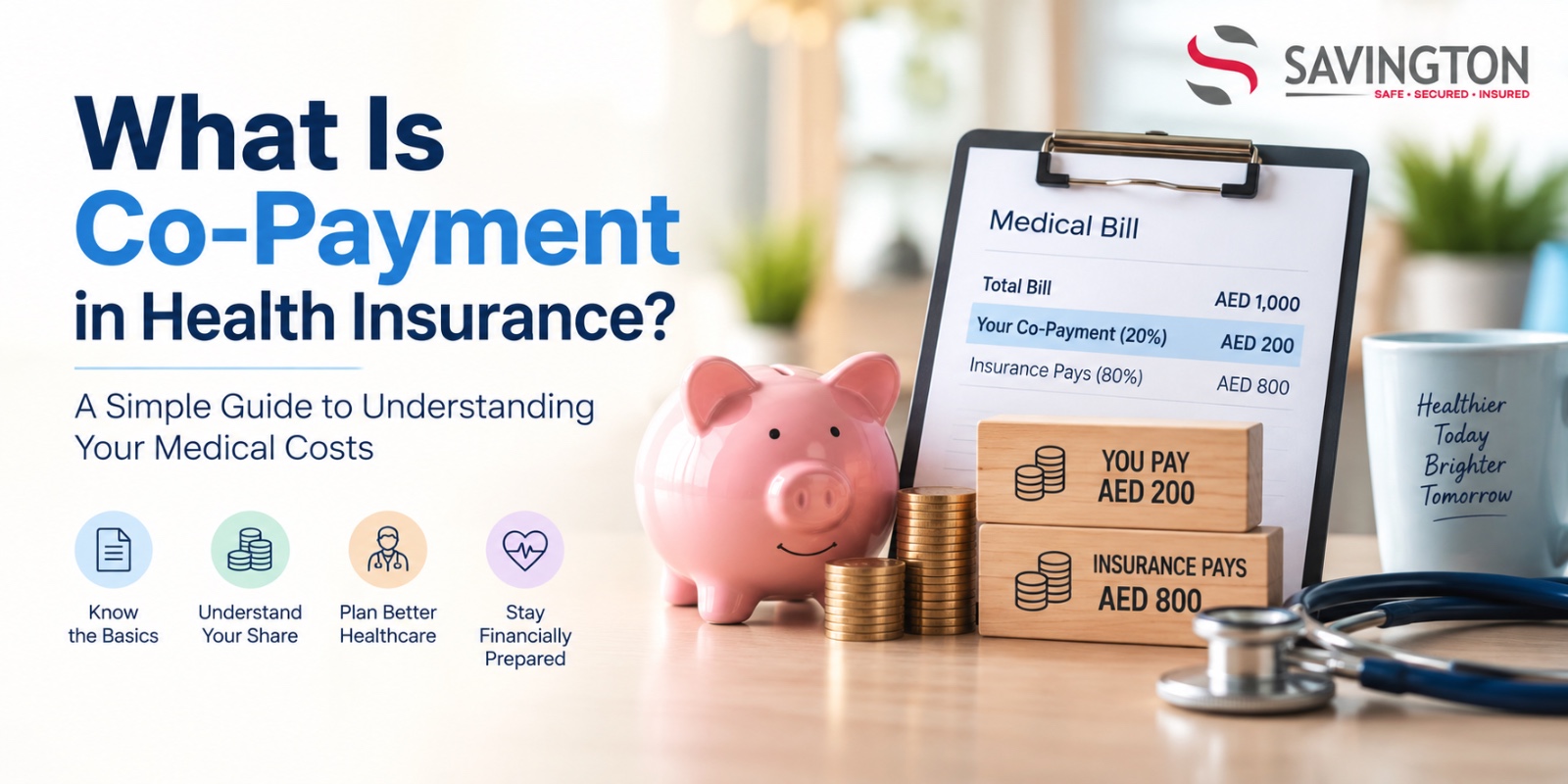
What Is Co-Payment in Health Insurance? A Simple Guide to Understanding Your Medical Costs
Health insurance helps reduce the financial burden of medical treatment, but it does not always mean that your insurance company pays every dirham of every medical bill. One important term that policyholders need to understand is Co-Payment in Health Insurance.
Many people focus on the annual premium when buying a policy but pay less attention to how much they may need to contribute when visiting a doctor, purchasing medicines, undergoing tests, or receiving hospital treatment. This is where a co-payment can make a significant difference.
Simply put, a co-payment is the portion of a covered medical expense that you may be required to pay yourself, while the insurer pays the remaining covered amount according to the terms of your policy.
For anyone comparing Health Insurance in Dubai or elsewhere in the UAE, understanding co-payment can help avoid unexpected out-of-pocket expenses. At Savington Insurance, helping customers understand these policy details is an important part of choosing coverage that provides real value.
Understanding How Co-Payment Works
The easiest way to understand What Is Co-Payment in Health Insurance is to think of it as cost-sharing between you and your insurance provider.
Your policy may state that you need to pay either a fixed amount or a percentage when receiving certain covered healthcare services. The insurer then pays the remaining eligible amount, subject to the policy’s limits and terms.
For example, imagine you receive medical treatment costing AED 500. If your Health Insurance Co-Payment is 20%, you may be responsible for paying AED 100, while the insurer pays the remaining eligible AED 400.
The actual amount can vary depending on your insurance policy and the type of treatment you receive.
A policy may apply different co-payment arrangements to:
- Doctor consultations
- Specialist appointments
- Diagnostic tests
- Prescription medicines
- Outpatient treatment
- Hospitalisation
This is why checking the policy benefits table is important. A co-payment percentage that seems small may create noticeable expenses if you require medical care regularly.
Co-Payment Can Differ Between Medical Services
Not every healthcare service necessarily has the same Co-Payment in Health Insurance.
Some policies may have different cost-sharing arrangements for outpatient consultations, medicines, diagnostic tests, or inpatient treatment. The amount you pay can therefore depend on the service you are receiving and the terms of your particular policy.
For example, a policy could have one contribution level for visiting a doctor and another for purchasing prescribed medication.
This makes it important to avoid assuming that your Health Insurance Co-Payment works in the same way across every medical service.
Before choosing a policy, check:
- The co-payment percentage or fixed amount
- Whether it applies to outpatient treatment
- Whether it applies to hospitalisation
- Medication contribution requirements
- Per-visit limits, if applicable
- Annual limits on your contribution
- Any services that do not require a co-payment
Understanding these details gives you a clearer picture of your potential healthcare costs.
For people searching for Co-Payment in Health Insurance UAE, the most important rule is simple: always check the wording and benefits of the specific plan rather than assuming that every health insurance policy follows the same structure.
Co-Payment Is Different From Your Insurance Premium
One common source of confusion is mixing up your premium and your co-payment.
Your insurance premium is the amount paid to maintain your health insurance coverage. Your Health Insurance Co-Payment, on the other hand, is the amount you may contribute when you actually use certain healthcare services.
This means that a policy with a lower premium may not always result in lower overall healthcare expenses.
Some lower-cost policies may require policyholders to contribute more when receiving treatment. A plan with a higher premium may offer lower out-of-pocket contributions for certain covered services.
When comparing Health Insurance in Dubai, it is therefore important to look at both sides of the cost:
What do you pay for the policy?
And
What could you pay when you actually need medical care?
The best option is not always the plan with the lowest annual premium. It is the plan that offers a suitable balance between the cost of coverage and your potential out-of-pocket healthcare expenses.
Co-Payment and Deductibles Are Not the Same
Another important distinction is between a co-payment and a deductible.
A Co-Payment in Health Insurance generally refers to the share you pay when receiving a covered healthcare service. A deductible is a different policy feature and refers to an amount that may need to be paid under the policy structure before certain insurance benefits apply.
These terms can affect how much you pay from your own pocket, which is why both should be reviewed carefully before purchasing a policy.
If you regularly visit doctors or require ongoing treatment, these costs can become particularly important.
When reviewing Co-Payment in Health Insurance UAE, ask your insurer or broker to clearly explain:
- How much you pay per medical service
- Whether your contribution is a percentage or fixed amount
- Whether a deductible applies
- Whether there are limits on your payments
- Which services have different contribution requirements
A clear understanding of these terms can help you compare policies based on their real financial impact.
Choosing the Right Balance for Your Healthcare Needs
There is no single co-payment structure that is right for everyone.
Someone who rarely visits a doctor may be comfortable with a policy that has a lower premium and higher out-of-pocket contributions. Someone who regularly needs consultations, medication, or specialist care may prefer a plan with broader benefits and lower contributions when using healthcare services.
When choosing Health Insurance in Dubai, consider:
- How often you and your family visit doctors
- Whether you require regular medication
- Your preferred hospitals and clinics
- Your expected healthcare requirements
- Your budget for premiums
- Your ability to manage unexpected medical expenses
Understanding What Is Co-Payment in Health Insurance can help you make a more informed comparison instead of choosing a policy based only on its price.
At Savington Insurance, comparing these details can help customers understand the complete cost of their health insurance and select coverage that matches their individual circumstances.
Final Thoughts
A Co-Payment in Health Insurance may seem like a small policy detail, but it can directly affect how much you pay whenever you receive medical treatment.
Before buying or renewing a policy, check how your Health Insurance Co-Payment applies to consultations, medicines, diagnostic tests, outpatient treatment, and hospitalisation.
For anyone comparing Co-Payment in Health Insurance UAE, the goal should be to understand the complete financial picture—not just the annual premium.
The right health insurance policy should offer a balance between affordable premiums and manageable out-of-pocket costs. By understanding your co-payment before you need medical treatment, you can make a more confident and informed insurance decision.
MUST READ: What Actually Happens If Your UAE Health Insurance Lapses
Get a Quote Today!
Let us help you protect your business and your employees with our comprehensive Workmen’s Compensation Insurance solutions.
Contact us at +971 4 3962333 (Savington Insurance Brokers Dubai) or visit https://savington.ae/ to learn more about our insurance offerings.






 ×
×